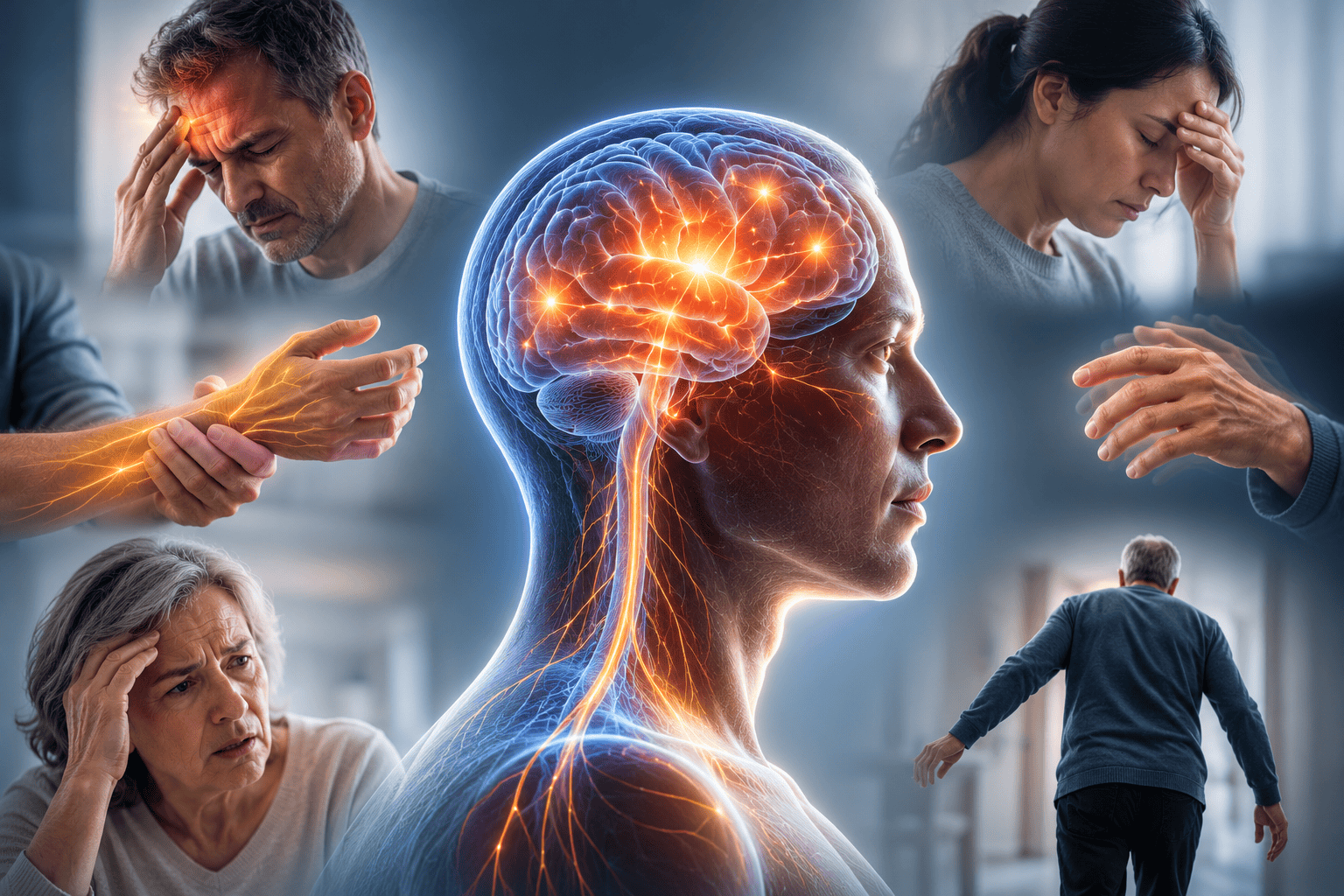

Feeling unusually unsteady, frequently stumbling, or having difficulty coordinating your hands and legs may sometimes be related to ataxia.
Ataxia is not one specific disease. It describes problems with coordination that can affect walking, balance, hand movements, speech, swallowing, and even eye movements. It can develop gradually or appear suddenly depending on the underlying cause.
Quick Answer: What Is Ataxia?
Ataxia means the nervous system is having difficulty coordinating voluntary movements.
People with ataxia may experience:
- Unsteady walking
- Poor balance
- Frequent falls
- Clumsy hand movements
- Difficulty with fine motor tasks
- Changes in speech
- Abnormal eye movements
- Difficulty swallowing
Many forms of ataxia involve the cerebellum, the part of the brain responsible for coordinating movement and balance. However, problems involving the spinal cord or peripheral nerves can also contribute to ataxia.

What Does Ataxia Feel Like?
Ataxia can affect people differently.
Someone may notice that they:
- Walk with their feet farther apart
- Frequently stumble or lose balance
- Have difficulty walking in a straight line
- Struggle to button clothing or use utensils
- Have trouble writing clearly
- Develop slurred or unusual speech
- Have difficulty coordinating their hands
- Experience uncontrolled eye movements
Symptoms may be mild at first or may significantly interfere with everyday activities.
What Causes Ataxia?
There are many possible causes, which is why neurological evaluation is important.
Stroke
A stroke affecting the cerebellum or nearby brain pathways can cause sudden problems with balance and coordination.
Sudden ataxia may occur along with:
- Dizziness
- Slurred speech
- Weakness
- Numbness
- Vision changes
- Severe headache
Sudden onset should be treated as a medical emergency.
Multiple Sclerosis
Multiple sclerosis can damage nerve pathways involved in coordination and movement.
Some people with MS may experience balance problems, tremor, weakness, or difficulty coordinating movements.
Brain Tumors or Other Structural Problems
A tumor or another abnormality affecting the cerebellum may interfere with balance and movement.
Symptoms may develop gradually depending on the location and cause.
Head Injury
Injury to parts of the brain responsible for coordination can lead to problems with walking, balance, or movement.
Vitamin Deficiencies
Deficiencies involving certain nutrients, including vitamins B1, B12, and E, can affect the nervous system and contribute to coordination problems.
Medications and Alcohol
Certain medications can affect balance and coordination. Long-term heavy alcohol use can also damage the cerebellum and lead to persistent ataxia.
Genetic Conditions
Some forms of ataxia are inherited.
Examples include different types of spinocerebellar ataxia and Friedreich ataxia. These conditions may begin during childhood, adolescence, or adulthood and can gradually progress over time.
Is Ataxia the Same as Dizziness?
No.
Dizziness may describe feeling lightheaded, faint, or as if the room is spinning.
Ataxia specifically refers to difficulty coordinating movement.
However, someone may experience both dizziness and ataxia at the same time, especially when the nervous system or balance system is affected.
Is Ataxia the Same as Muscle Weakness?
Not necessarily.
Someone with ataxia may have normal muscle strength but still have difficulty controlling movements accurately.
For example, a person may have enough strength to walk but still:
- Stagger
- Misplace their steps
- Lose balance
- Have difficulty turning
- Struggle with coordinated movements
Weakness and ataxia can also occur together depending on the underlying condition.
How Is Ataxia Diagnosed?
Diagnosis begins with understanding when the symptoms started and whether they are worsening, recurring, or appearing suddenly.
A neurological examination may evaluate:
- Walking and balance
- Coordination
- Reflexes
- Muscle strength
- Sensation
- Eye movements
- Speech
The pattern of these findings can help determine which parts of the nervous system may be involved.
What Tests May Be Needed?
Testing depends on the patient’s symptoms and medical history.
MRI
Brain MRI may help identify problems involving the cerebellum or other areas of the brain, including structural abnormalities, tumors, or evidence of stroke.
Blood Tests
Blood testing may identify potentially treatable causes such as nutritional deficiencies, metabolic abnormalities, or certain medical conditions.
Nerve Testing
If numbness, tingling, or sensory changes are present, nerve and muscle testing may be recommended.
Lumbar Puncture
In selected situations, a lumbar puncture may help evaluate inflammation, infection, or other neurological conditions.
Additional testing, including genetic testing, may be considered when an inherited form of ataxia is suspected.
How Is Ataxia Treated?
There is no single treatment for every person with ataxia.
Treatment depends primarily on what is causing the coordination problem.
For example, treatment may involve addressing:
- Vitamin deficiencies
- Medication side effects
- Infections
- Autoimmune conditions
- Multiple sclerosis
- Stroke-related complications
- Other neurological disorders
When the underlying condition cannot be completely reversed, treatment may focus on maintaining mobility, independence, and safety.
Can Therapy Help?
Yes.
Depending on the symptoms, rehabilitation may include:
Physical therapy to improve mobility, strength, balance, and coordination.
Occupational therapy to help with everyday activities.
Speech therapy when speech or swallowing is affected.
Some people may also benefit from assistive devices such as canes or walkers to improve stability and reduce fall risk.
When Is Ataxia an Emergency?
Sudden problems with coordination or walking require immediate attention.
Call 911 if sudden balance or coordination problems occur with:
- Facial drooping
- Weakness or numbness on one side
- Difficulty speaking
- Sudden vision changes
- Severe dizziness
- Sudden severe headache
- Confusion
Sudden ataxia can be a sign of a stroke or another serious neurological condition.
Frequently Asked Questions
Ataxia is generally a symptom or clinical finding rather than one single disease. Many different neurological and medical conditions can cause it.
Yes. Sudden ataxia can occur with conditions such as stroke and requires urgent medical evaluation.
Some inherited or degenerative forms can gradually progress. Other forms may improve when an underlying treatable cause is identified.
Treatment depends on the cause. Some causes may be reversible or treatable, while other forms require symptom management and rehabilitation.