

Pain that begins in your neck and travels into your shoulder, arm, hand, or fingers may be more than simple muscle soreness. In some cases, these symptoms develop when a nerve in the cervical spine becomes irritated or compressed.
This condition is commonly known as a pinched nerve in the neck and medically referred to as cervical radiculopathy.
Understanding the pattern of your symptoms can help determine when home care may be enough and when a neurological evaluation may be appropriate.
Can a Problem in Your Neck Really Cause Arm Pain?
Yes.
Nerves that originate in the cervical spine travel through the shoulders and arms and into the hands and fingers. When one of these nerves becomes compressed or irritated, symptoms may be felt anywhere along the path of that nerve.
This is why a problem in the neck can sometimes cause symptoms far away from the neck itself.
You may experience:
- Pain that travels from the neck into the shoulder or arm
- Burning or sharp pain
- Tingling or a “pins and needles” sensation
- Numbness in the arm, hand, or fingers
- Weakness in the shoulder, arm, or hand
- Difficulty gripping or holding objects
- Symptoms that worsen with certain neck movements
Some people experience neck pain along with these symptoms, while others mainly notice discomfort in the arm or hand.
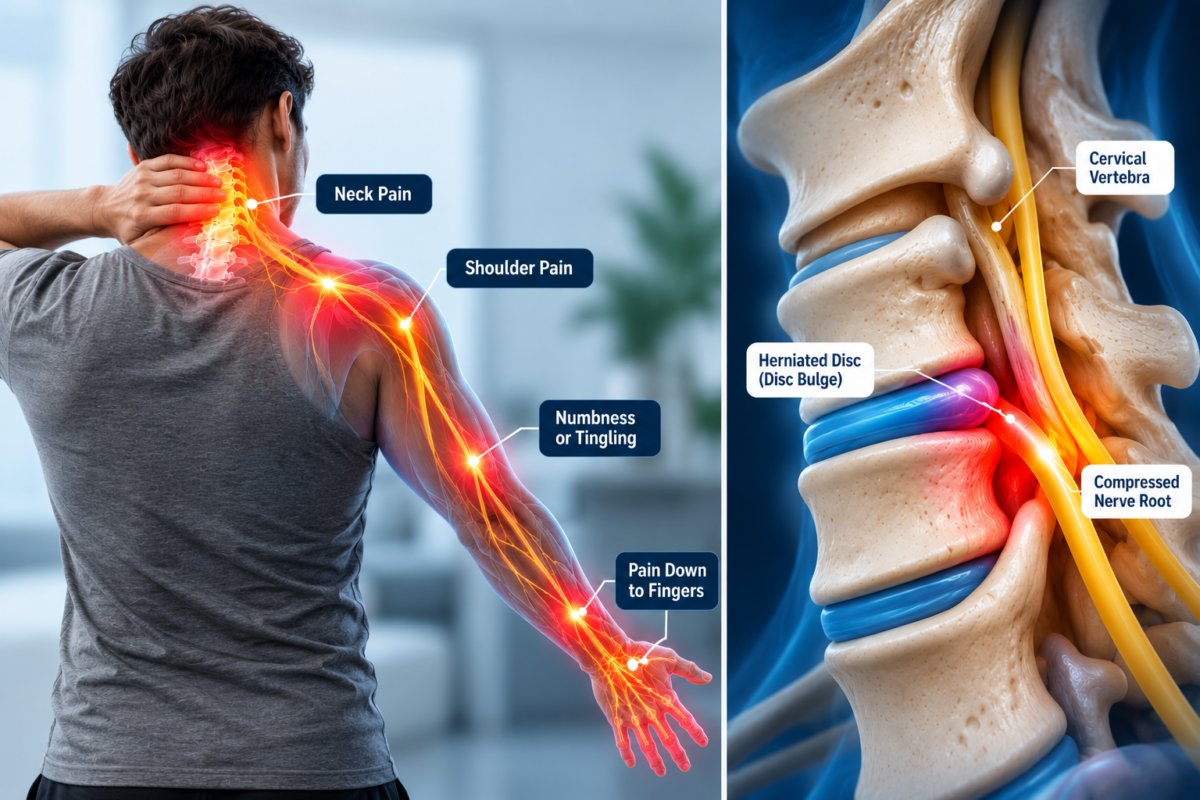
What Is Cervical Radiculopathy?
Cervical radiculopathy occurs when a nerve root in the neck becomes irritated or compressed.
The cervical spine consists of seven vertebrae in the neck. Nerves exit between these vertebrae and travel to different areas of the shoulders, arms, and hands.
Compression of a particular nerve can produce symptoms in a specific area of the arm or fingers.
For example, one person may experience tingling in the thumb, while another may notice symptoms in the middle or little fingers depending on which nerve is affected.
What Causes a Pinched Nerve in the Neck?
Several conditions can place pressure on the nerves in the cervical spine.
Herniated Disc
The discs between the vertebrae act as cushions. If part of a disc bulges or herniates, it may press against a nearby nerve.
Degenerative Disc Changes
As spinal discs change with age, they may lose height or flexibility, reducing the space available for nearby nerves.
Bone Spurs
Arthritis and age-related changes in the spine can lead to additional bone growth that may narrow the space through which nerves travel.
Cervical Spinal Stenosis
Spinal stenosis occurs when the spaces within the spine become narrower, potentially placing pressure on nerves or, in more serious cases, the spinal cord.
Neck Injury
Trauma from an accident, sports injury, or sudden movement may irritate or compress cervical nerves.
What Does Nerve Pain From the Neck Feel Like?
Nerve-related pain can feel different from ordinary muscle pain.
Patients often describe it as:
- Sharp
- Shooting
- Burning
- Electric
- Tingling
- Radiating
The pain may begin around the neck or shoulder blade and travel down one arm.
Certain movements, such as turning or tilting the head, may make symptoms worse.
Can a Pinched Nerve Cause Hand Weakness?
Yes.
Because cervical nerves help control muscles in the arms and hands, nerve compression may affect strength as well as sensation.
Possible signs include:
- Weak grip
- Dropping objects unexpectedly
- Difficulty lifting the arm
- Trouble opening jars or holding utensils
- Difficulty performing tasks that require finger coordination
Persistent or worsening weakness should be medically evaluated.
Is Arm Tingling Always Caused by the Neck?
No.
Tingling, numbness, and arm pain can have several possible causes.
Other conditions may include:
- Carpal tunnel syndrome
- Peripheral neuropathy
- Ulnar nerve compression
- Shoulder conditions
- Diabetes-related nerve damage
- Circulation problems
- Other neurological disorders
A medical evaluation can help determine where the symptoms are actually coming from.
How Is Cervical Radiculopathy Diagnosed?
Evaluation usually begins with a detailed discussion of your symptoms.
A healthcare professional may ask:
- Where does the pain begin?
- Where does it travel?
- Which fingers feel numb or tingly?
- Are you experiencing weakness?
- What movements make symptoms worse?
- How long have the symptoms been present?
A neurological examination may evaluate:
- Muscle strength
- Reflexes
- Sensation
- Coordination
- Range of motion
The pattern of these findings can sometimes indicate which cervical nerve may be affected.
What Tests May Be Needed?
Not everyone with neck and arm pain requires extensive testing.
Depending on the symptoms, a neurologist may recommend:
MRI
An MRI can show the discs, nerves, spinal cord, and other structures within the cervical spine.
It may help identify a herniated disc, spinal stenosis, or other causes of nerve compression.
EMG and Nerve Conduction Studies
An electromyography (EMG) and nerve conduction study (NCS) evaluate how nerves and muscles are functioning.
These tests may help determine whether symptoms are coming from a cervical nerve root or from another nerve problem farther down the arm.
Additional Testing
In certain cases, other imaging or laboratory tests may be recommended depending on the symptoms and medical history.
How Is a Pinched Nerve in the Neck Treated?
Treatment depends on the cause and severity of the nerve compression.
Many cases improve with conservative treatment.
Possible treatment options may include:
- Activity modification
- Physical therapy
- Posture correction
- Anti-inflammatory medications when appropriate
- Medications used for nerve-related pain
- Heat or cold therapy
- Guided exercises
- Injections in selected cases
If significant nerve compression causes progressive weakness or other serious neurological symptoms, additional evaluation by a spine specialist may be necessary.
Surgery is generally considered only in selected cases when symptoms are severe, neurological problems are progressing, or conservative treatment has not provided enough relief.
Can You Ignore a Pinched Nerve?
Mild nerve irritation may improve with time and appropriate care.
However, persistent compression should not simply be ignored, particularly when symptoms include weakness, increasing numbness, or loss of hand function.
Prolonged or severe nerve compression can, in some cases, lead to lasting nerve dysfunction.
Early evaluation can help identify the cause and determine the appropriate treatment.
When Should You See a Neurologist?
Consider a neurological evaluation if you experience:
- Neck pain that repeatedly travels into the arm
- Persistent numbness or tingling
- Weakness in the arm or hand
- Frequently dropping objects
- Symptoms affecting both arms
- Difficulty with fine hand movements
- Symptoms that continue despite conservative care
- Increasing pain or neurological symptoms
A neurologist can help determine whether your symptoms are related to a compressed cervical nerve or another neurological condition.
When Is Neck and Arm Pain an Emergency?
Seek urgent medical attention if neck or arm symptoms occur with:
- Sudden severe weakness
- Difficulty walking
- Loss of balance
- Loss of bladder or bowel control
- Numbness around the groin or pelvic area
- Severe symptoms after significant trauma
- Sudden facial weakness or speech difficulty
- Sudden weakness or numbness on one side of the body
These symptoms may indicate a more serious neurological or spinal condition and should be evaluated immediately.